
Cash vs accrual: the accounting choice that sets your tax bill
Cash basis taxes what you collect and accrual taxes what you earn — here's who gets to choose, who has to switch, and how to make the timing work for you.

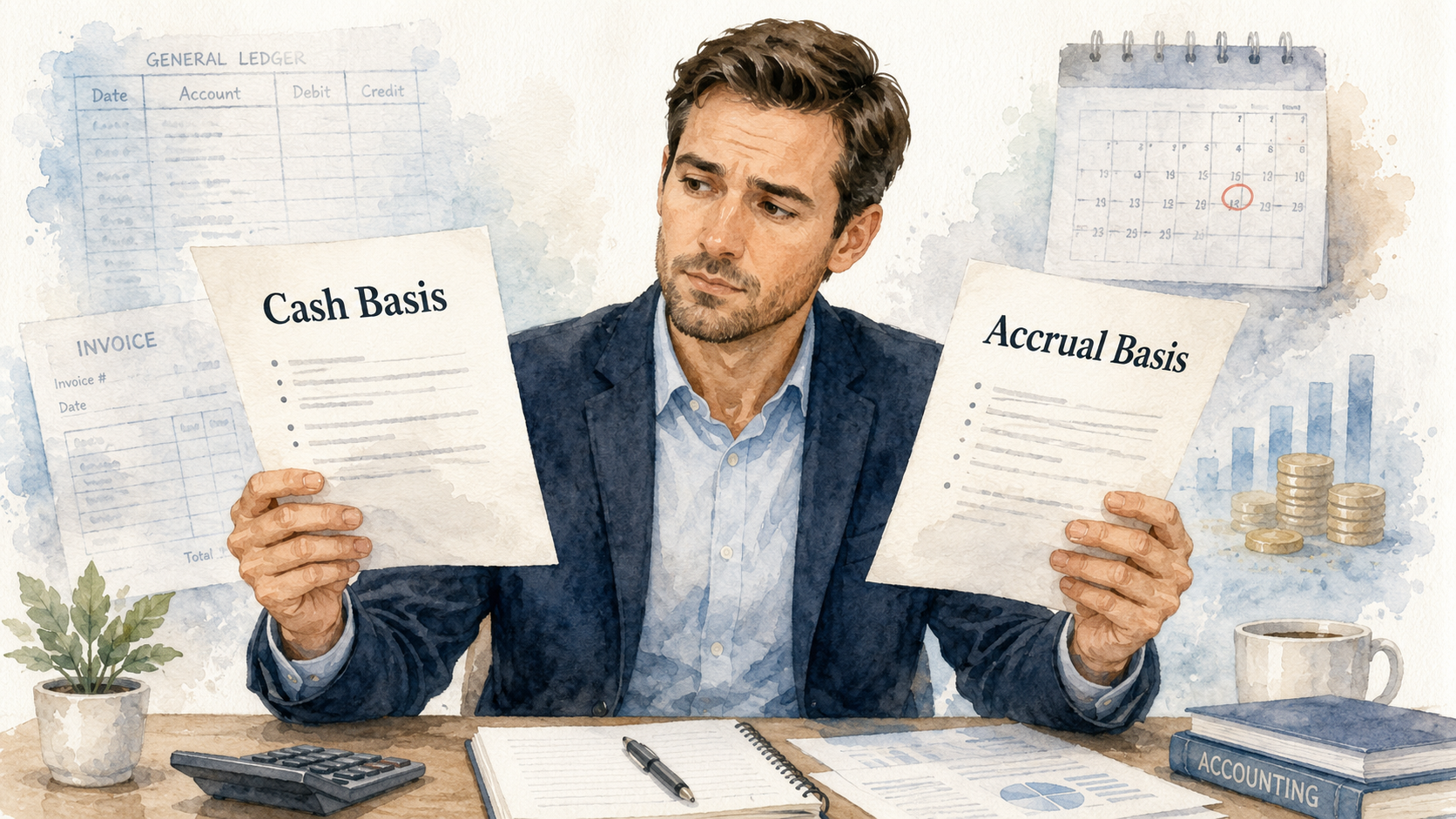
Cash vs accrual is the accounting method choice every US business makes, and it decides when a dollar of income becomes taxable. Cash basis counts income the day payment lands and expenses the day you pay them; accrual counts income when you earn it and expenses when you incur them. For most small businesses the choice is genuinely yours to make. In our 200-client Miami practice it’s the first question we ask at onboarding, and the one owners are most surprised to learn they answered by default, years ago, on their very first tax return.
The good news: the decision is simpler than the vocabulary around it. Here’s what actually separates the two methods, what the tax code says about who can use which, the year-end levers each one unlocks, and which side your business belongs on. The IRS lays out the full rules in Publication 538, but the short version fits on one page.
The difference in one invoice
Say you invoice a client $12,000 on December 15 and they pay on January 20. On the cash basis — income recorded when received, expenses when paid — that’s next year’s revenue. On the accrual basis — income recorded when earned, expenses when incurred — it’s this year’s, no matter when the money lands.
The same logic runs in reverse on costs. A $4,000 contractor bill dated December 28 and paid January 5 is a December deduction on accrual and a January deduction on cash.
Over the life of a business, both methods tax the same dollars. What they change is timing — and in tax, timing is money. Income pushed into next year is tax you don’t owe for another twelve months, cash that sits in your account instead of the Treasury’s.
| Cash basis | Accrual basis | |
|---|---|---|
| Income counts when | Payment hits your account | You earn it — invoice date |
| Expense counts when | You pay the bill | You incur the cost |
| $12,000 invoiced Dec 15, paid Jan 20 | Next year’s income | This year’s income |
| Best for | Service firms, trades, consultants | Inventory, lenders, buyers |
| Bad debt write-off | Not available | Deductible |
| Who can use it | Most businesses under $32M | Anyone |
Who gets to choose, under Section 448(c)
Sole proprietors, S corporations and most partnerships can use the cash method at any size, as long as the business isn’t what the code calls a tax shelter — a technical label that catches loss-allocating investor syndicates, not your LLC. C corporations, and partnerships with a C corporation as a partner, get cash only by passing the gross receipts test of Section 448(c): average annual gross receipts of $32 million or less over the prior three years, a ceiling the IRS re-indexes for inflation every year.
Inventory used to force the issue — if you carried it, you used accrual, full stop. Since 2018 that’s gone for small businesses: under Section 471(c), a company that passes the same gross receipts test can treat inventory as non-incidental materials and supplies and stay on cash. The IRS walks through both tests, with the current year’s dollar threshold, in Publication 334, its guide for small businesses.
One method you can’t pick à la carte: whatever you choose has to be applied consistently across the whole business. If you use cash for income, you use it for expenses too. Mixing — sometimes called a hybrid method — is allowed only in narrow cases, mainly when inventory is accounted for on accrual while everything else runs on cash.
Cash basis taxes what you've collected; accrual taxes what you've earned. The gap between those two numbers is your year-end planning window.
The year-end levers each method unlocks
On cash, the calendar is the strategy:
- Defer income. Work finished in mid-December can be invoiced on January 2, and the revenue moves into the new year with it. One hard limit: constructive receipt. You can hold an invoice; you can’t hold a check. Once payment is available to you, it’s income — deposited or not.
- Accelerate expenses. Pay January’s bills in December. Under the 12-month rule, a cash-basis business can generally deduct prepayments covering up to a year ahead — insurance, software subscriptions, professional retainers.
On accrual, the levers are quieter but real:
- Deduct before you pay. Costs incurred by December 31 are deductible even if the cash leaves in January — including staff bonuses, provided they’re paid within 2½ months of year-end.
- Write off bad debts. An accrual business has already paid tax on a receivable, so an invoice that proves uncollectible becomes a deduction. A cash business gets no write-off; it never booked the income in the first place.
Which businesses belong on which side
- Service firms, consultants and trades: cash. Little or no inventory, revenue that tracks collections, and full control of year-end timing. This is most of the owners we onboard.
- Inventory businesses — retail, e-commerce, wholesale, light manufacturing: accrual, at least in the books. Even where the code allows cash, you can’t see real margins without matching cost of goods sold (COGS — the direct cost of what you sold) to the month you sold it.
- Anyone courting a bank or a buyer: accrual. Lenders and due-diligence teams read accrual statements; a cash-basis profit-and-loss on a growing company understates revenue and hides what’s owed.
- Deposit- and prepayment-heavy models: run the math. Cash taxes an advance payment the day it lands. Accrual can push recognition to when the work gets done, generally up to a year out.
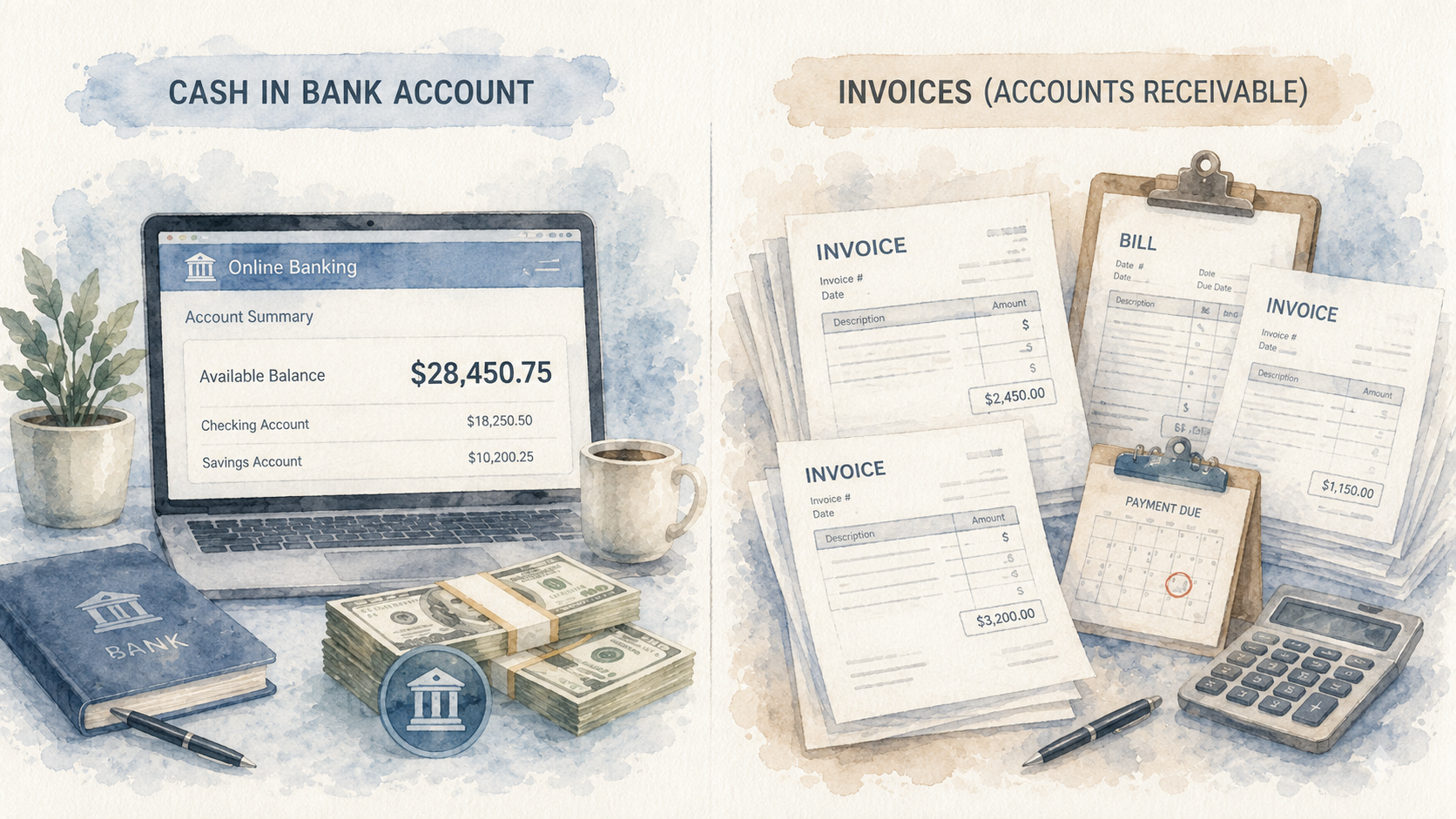
Whichever side you land on, both QuickBooks and Xero keep the books on accrual internally and generate cash-basis reports on demand — so the software is never the constraint. The constraint is whether someone reconciles the accounts every month, which is what makes either set of numbers true. Our seven-step monthly close is the version we run for clients.
The setup most owners actually run
Here’s the part most posts skip: your books and your tax return don’t have to use the same method. Plenty of well-run companies keep accrual books all year — so management sees true margins — and file a cash-basis return, reconciling the difference once at close. Our bookkeeping service is built around exactly that split.
Switching methods is a filing, not a fire drill. The change goes to the IRS on Form 3115, most small-business changes qualify for automatic consent, and the catch-up — the Section 481(a) adjustment — follows a friendly rule: a favorable adjustment is deducted in full in the year of the change, while an unfavorable one is spread over four years. A business moving from accrual to cash while sitting on large receivables can take that favorable catch-up all at once.
There’s a cash-flow consequence worth pricing in before you switch. Moving from accrual to cash usually drops taxable income in year one, which means your quarterly estimated payments are now too high — and if you don’t adjust them, you hand the Treasury an interest-free loan until you file. Moving the other direction does the reverse: taxable income jumps, and an unchanged estimate can leave you underpaid and facing a penalty.
One brake: consistency. You generally can’t use the streamlined process for the same change again within five years, so pick a lane for reasons that will still be true in year three.
Frequently asked questions
Can I use cash basis if I carry inventory?
Yes, in most cases. Section 471(c) lets a business that passes the $32 million gross receipts test treat inventory as non-incidental materials and supplies and stay on the cash method. Whether you should is a different question — without matching cost of goods sold to the month of the sale, your margins on paper won’t match reality.
Which method is better for taxes?
Neither, over the life of the business — both tax the same dollars. Cash usually wins for a service business, because deferring December invoices into January defers the tax with them. Accrual wins when you’re sitting on uncollectible receivables you can write off, or when you need to deduct year-end costs you haven’t paid yet.
How do I know which method I’m on right now?
It’s printed on your last filed return. On a Schedule C it’s line F; on Form 1120-S and Form 1065 it’s the first question of Schedule B. If nobody ever discussed it with you, you’re almost certainly on cash — it’s the default most preparers select.
Do I have to change my bookkeeping to change my tax method?
No. Books and return are separate choices, and running accrual books with a cash-basis return is a common, entirely legitimate setup. The reconciliation happens once, at year-end close.
How long does switching take?
The filing itself is Form 3115, submitted with the return for the year of the change. Most small-business changes qualify for automatic consent, so there’s no waiting on an IRS ruling. Plan for one close cycle to compute the Section 481(a) adjustment.
What we tell clients
Most owners never chose a method — their first preparer did, on line F of a Schedule C, and it has rolled forward ever since. We review it in month one: accrual books for management, and the return filed on whichever method the code allows and the math favors, which is where real tax planning starts. If you’d like a method review for your business, book a call and bring your most recent filed return — your current method is printed right on it.