The Trump Dividend: a $5,000 check, a $40 trillion bill
Trump is promising $5,000 per adult if Republicans hold Congress in November. The math: $1.2 trillion, voided tariffs and $40 trillion in national debt.

Some promises are made with your own checkbook in hand, and others with the neighbor’s. The one made last Wednesday in Dallas belongs to a third, more innovative category: it was made with a checkbook the Supreme Court has already voided.
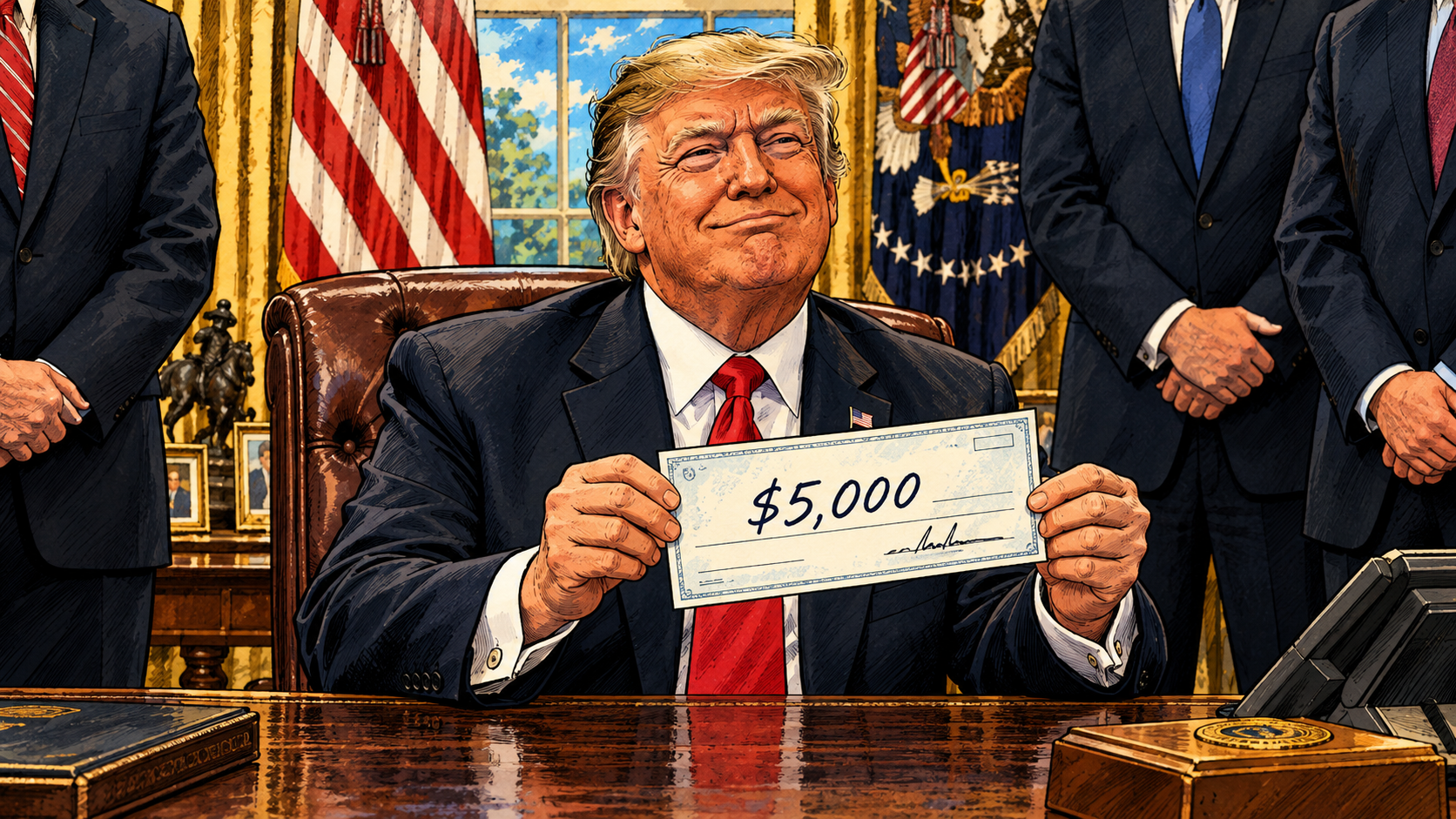
At the Republican Party’s first-ever “midterm convention,” President Donald Trump announced the so-called Trump Dividend: a $5,000 check for every adult citizen, provided — and here is the fine print that isn’t so fine — that Republicans hold both the House and the Senate on November 3. “If the Republicans win, you win with us and you get $5,000,” he said, with the ease of someone running a church raffle. The difference is that at a church raffle, somebody bought the prize before announcing it.
How much would the Trump Dividend cost? The math nobody did on stage
The United States has roughly 245 million adult citizens. Multiply that by $5,000 and you land around $1.2 trillion; Reuters gets to $1.35 trillion by counting all of the country’s roughly 270 million adults, not just citizens. For scale: the entire federal discretionary budget for fiscal year 2026 — defense, education, justice, highways, national parks, NASA and the rest of the catalog — comes to $1.6 trillion. The dividend alone equals nearly three-quarters of all that, and more than 15% of total federal spending last year.
Erica York, an economist at the Tax Foundation, put it in even less friendly terms: the check would swallow almost all the revenue the new tariffs are projected to bring in over a decade. Not over a year. Over ten.
Asked the next day, the president said he doesn’t think congressional approval is needed; House Speaker Mike Johnson later said it is. It is a position consistent with his recent track record on “I don’t need permission” — a record the Supreme Court reviewed in February, with results we’ll get to in a moment.
Tariffs: the well the money would come from (and is already draining out of)
The funding, Vice President JD Vance suggested on Fox News, would come at least partly from tariffs. The idea has an impeccable internal logic: tariffs brought in $195 billion in fiscal 2025, an all-time record, and before the ruling they were on pace to top $350 billion this fiscal year. A sweet deal.
Until February 20, 2026, when the Supreme Court ruled 6-3 in Learning Resources, Inc. v. Trump that the International Emergency Economic Powers Act (IEEPA) does not authorize the president to impose tariffs. Not the “reciprocal” ones, not the “fentanyl” ones, not the Liberation Day ones. None of them. Retroactively. From day one.
What followed is one of the more colorful accounting operations in recent fiscal history: the government collected about $166 billion under an authority it never had, and is now paying it back, with interest, to some 330,000 importers. As of July 31, Customs and Border Protection (CBP) had paid out around $100 billion in refunds; by August 21, certified refunds had reached $106.6 billion, interest included.
Month by month, the picture gets even better. In May, net customs receipts came to minus $40 million. Minus. In June, $49.1 billion went out in refunds while $23.6 billion in new duties came in. In July, refunds ($33.4 billion) again exceeded collections ($24.8 billion), leaving a negative net flow of $8.6 billion. Only in August did the balance turn positive again, at $12.8 billion.
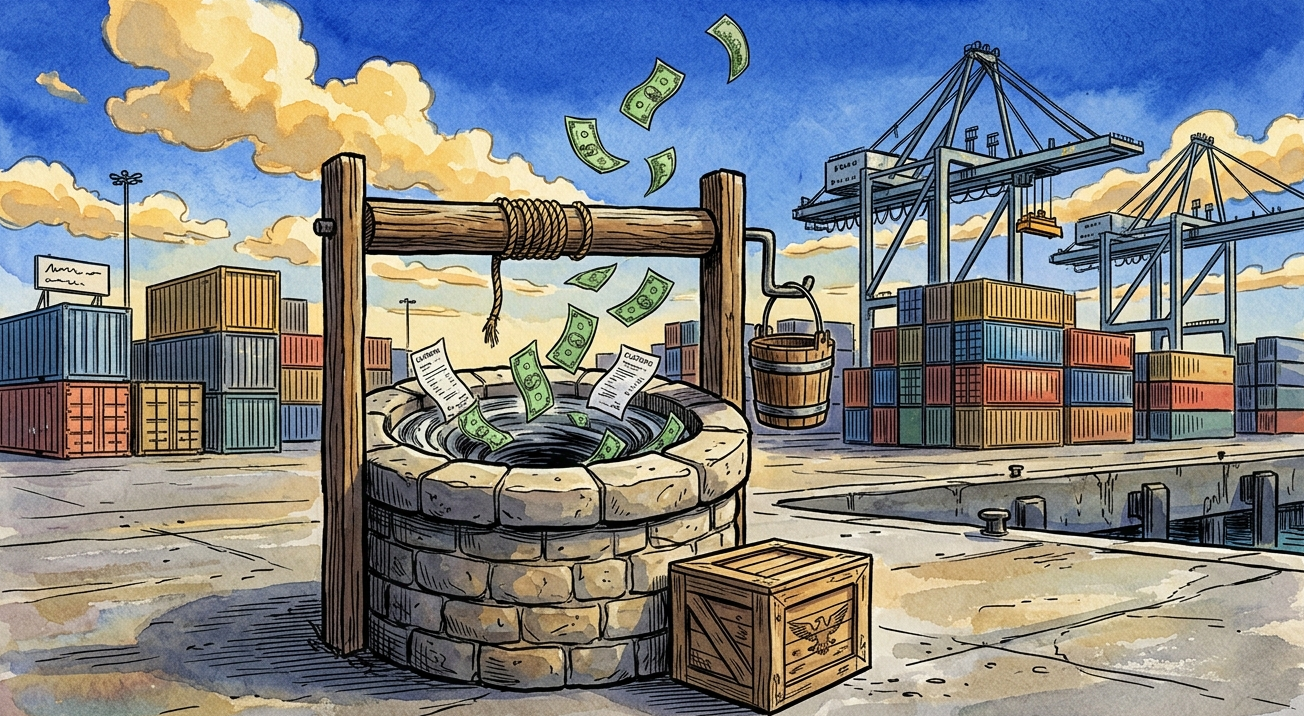
Put differently: the tariff “well” that was supposed to fund the checks spent three months working as a drain. The Congressional Budget Office (CBO) — the nonpartisan agency that produces the official fiscal projections for Congress — has already cut its 2026 tariff revenue estimate by about $250 billion, 60% below what it projected in February. The White House’s improvised replacement, a 10% global tariff under Section 122 of the Trade Act of 1974, didn’t close the gap either: it was lower than the tariffs that were struck down and, by law, could only last 150 days. It expired on July 24, and Section 301 tariffs of 10% to 12.5% have taken its place. Temporary patches on a permanent loss.
If your small business is one of those importers, the refund and the interest on it need to land correctly in your books and, in many cases, on your tax return. That is exactly the kind of detail we handle in bookkeeping.
Meanwhile, in the basement: $40 trillion in debt
The national debt passed $40 trillion in August. On September 10 it stood at $40.047 trillion, according to the Treasury’s daily debt tracker — a stone’s throw from the $41.1 trillion statutory limit set in last year’s budget reconciliation bill, the OBBBA. The fiscal 2026 deficit had already reached $1.97 trillion by the end of August, and the CBO projects the year will close at around $2.1 trillion.
The number that should keep any treasurer up at night is a different one: the country now pays more than $1 trillion a year in net interest alone — about $1.06 trillion over the past twelve months — more than it spends on defense. Interest is now the fastest-growing line in the federal budget. The CBO projects it will double to $2.1 trillion in 2036, when debt held by the public will reach $56 trillion — before counting any election-year checks.
This isn’t a Washington-only disease. Collecting less, spending more and covering the difference with ever-costlier debt is the same pattern that cost Colombia its investment-grade rating, as we laid out in our economic review of the Petro government.
Against that backdrop, proposing a $1.2 trillion payout — in an economy with rising inflation, low unemployment and the 30-year Treasury yield above 5% — is, in the words of Joe Brusuelas, chief economist at RSM US (one of the country’s largest audit and consulting firms), “the working definition of ill-timed and ill-advised fiscal policy.” And that came from someone who is paid to be diplomatic.
A $1.2 trillion check, funded by tariffs the Supreme Court struck down, on top of $40 trillion in debt: the math doesn't close.
The checks that never arrived: fourth time’s the charm
It’s worth recalling the check’s family tree. In February 2025 it was the $5,000 “DOGE dividends,” funded by savings DOGE never produced. In July 2025 it was a “little rebate” on tariffs with no amount attached; Senator Josh Hawley’s bill put it at $600. Between October and November 2025 it was the $2,000 “tariff dividend,” funded by tariffs the Court later struck down. Now it’s $5,000 contingent on an election result, funded by — as far as anyone can tell — the conviction that the country is “making a lot of money.” Zero of the three previous versions ever reached a mailbox. It is the administration’s most consistent record.
Several Republican lawmakers, privately and publicly, called the idea an election ploy that would be nearly impossible to pass. According to CNN, the announcement blindsided much of the White House — only a small circle of advisers knew — and aides spent Thursday morning scrambling to work out the “details”; the White House denies it was caught off guard. Even a small-business owner from Arlington, on the convention floor, summed it up with more rigor than the podium: “I’m not into free stuff.”
Epilogue, with the calculator switched off
It would be a mistake to read this episode as a math problem. It isn’t one. Nobody on that Dallas stage was solving an equation; they were solving an election. The debt is a number that gets paid in 2036, in 2046, with the taxes of people who can’t vote yet. The check is a number that gets cashed in November.
And for a man whose companies filed for Chapter 11 bankruptcy protection six times between 1991 and 2009 — and who walked out of each one more famous than before — red ink has never been an obstacle. If anything, it has been the business model.
In the end, what’s one more bankruptcy?